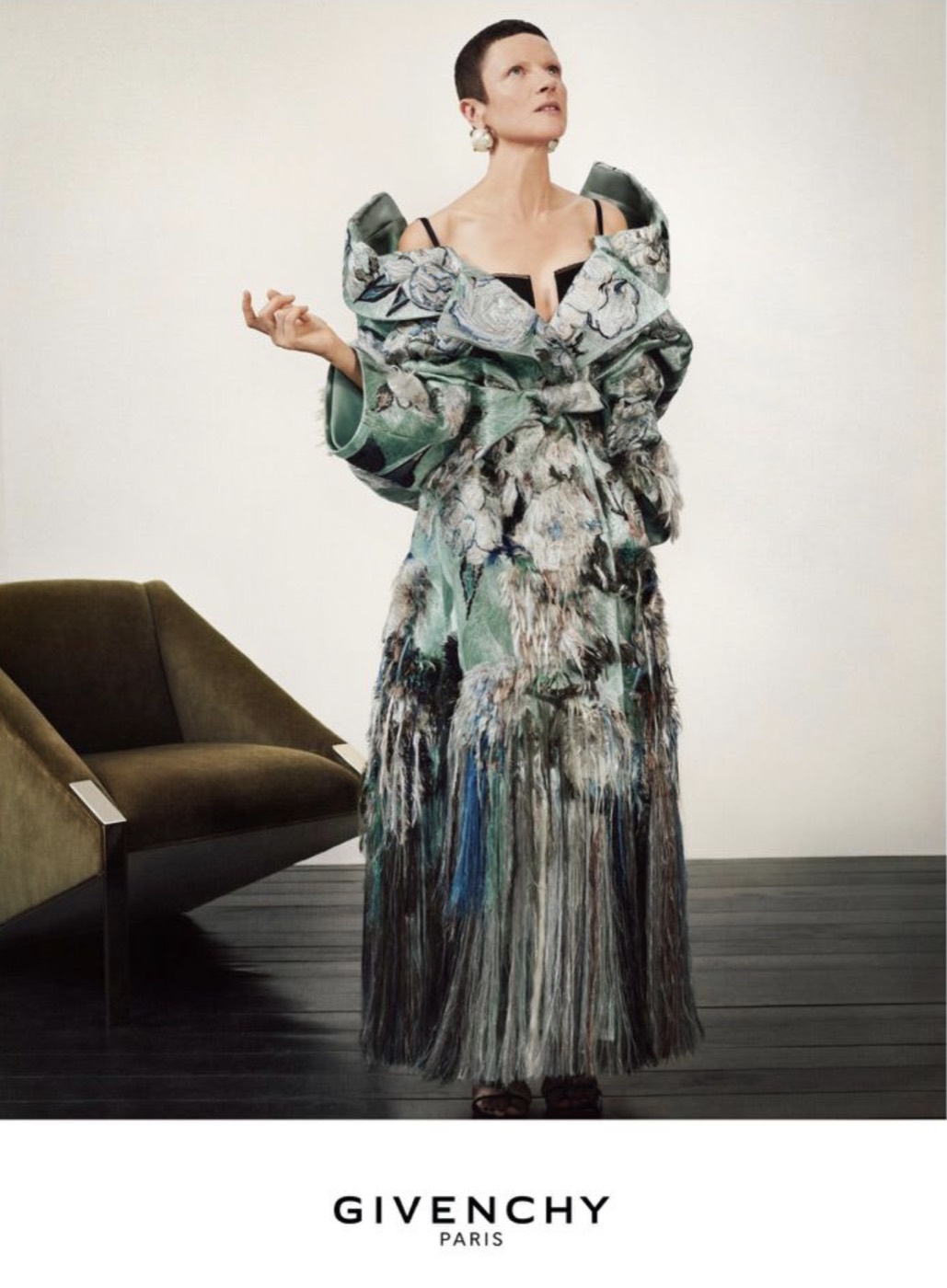

Fit worthy of the atelier
Across the maison's storefront
About the brand
Founded in 1952 by Hubert de Givenchy and today part of LVMH, Givenchy is one of the great Parisian couture houses, a maison whose history runs through Audrey Hepburn's wardrobe, the invention of aristocratic ease in ready-to-wear, and seven decades of collections where construction, silhouette and fit are not features of the product but the product itself. The house today spans haute couture, ready-to-wear, accessories and beauty, with a digital flagship that must carry the same authority as Avenue George V. That is a harder brief than it sounds: luxury e-commerce sells the maison's judgement as much as its garments, and every element on the page, every module, every interaction, either upholds couture-grade standards or dilutes them. Givenchy evaluates technology accordingly, and slowly: nothing reaches the flagship that the maison would not put its name to. Which made its decision on sizing a meaningful one.
Challenge
A couture maison cannot ship approximation. In the salon, fit is a conversation conducted by experts, the atelier's judgement applied to a client's body, piece by piece. Online, that entire apparatus disappears, leaving a size grid to speak for a house whose silhouettes are precisely constructed and intentionally varied: a structured jacket, a fluid gown and a knit carry three different fit philosophies, and a wrong size on a four-figure piece is not a return statistic, it is a failed client experience with a name attached. The constraint cut both ways: Givenchy needed guidance precise enough for couture-grade expectations, delivered discreetly enough for a luxury flagship, no gamified widgets, no vendor branding, nothing that would read as e-commerce machinery intruding on the maison's page. Most sizing tools fail one test or the other. Givenchy required both, and proof in a real market before any wider commitment.
Solution
Givenchy gave Kleep the go-ahead in September 2025, and the deployment went live in Italy in February 2026, a deliberate first market, measured before anything scaled. The experience is engineered to the maison's discretion: a refined fit consultation sitting quietly on the product page, fully white-labelled to Givenchy's art direction, with no visible trace of a third party. Underneath, the models do atelier-grade work, every piece calibrated individually on its actual construction and intended silhouette, so a sculpted blazer and a draped dress produce different answers for the same client. Clients build a measurement profile through Kleep's two-photo body scan or a brief questionnaire, and recommendations return in under 250 milliseconds, preserving the unhurried composure of the page. The result reads less like sizing technology than like the maison extending its fitting-room judgement to the screen, which was precisely the brief.
Results
Italy was the proving ground, and it proved. Following the February 2026 launch, Givenchy extended Kleep from the Italian storefront to its digital flagship worldwide, the maison's markets brought progressively onto the same fit foundation, a scaling decision made on observed performance in a live luxury market rather than on projection. For a house of Givenchy's standing, that rollout is itself the result that matters most: an LVMH maison judged the experience worthy of its name globally. The deployment also anchors Kleep's luxury credentials at the highest tier, the same engine now serves houses from Givenchy and Kenzo within LVMH to Rabanne at Puig, calibrated to couture constructions at one end of the portfolio while sizing flash-sale volume at the other. Three hundred brands live, a sizing flow every five seconds in 2026, and a couture maison's worldwide flagship among the references: quiet infrastructure, holding couture-grade weight.
Discover our other case studies
All stories
 Smart Sizing
ETAM lifts revenue 5% and cuts returns 16%, proven in a live A/B test
Europe's lingerie leader put Kleep on trial with a live A/B test. The verdict: +5% revenue, 16% fewer returns. ETAM's numbers, not ours.

 Smart Sizing
ba&sh runs Kleep head-to-head against True Fit, and never looks back
ba&sh A/B-tested Kleep against True Fit on real traffic: +20% usage, +88% add-to-cart. The switch made itself.
 Smart Sizing
How JOTT used AI to improve fit accuracy & reduce returns
Outerwear sizing left shoppers guessing, and parcels kept coming back. JOTT put Kleep's fit guidance on every product page, so the right size is the first size.
 Smart Sizing
Lacoste partners with Kleep for unmatched AI fit precision
Lacoste rolled AI fit precision across its global storefront. The polo that fits, first time, in every market.
 Smart Sizing
Bompard brings next-gen precision sizing to luxury knitwear
Precision sizing for cashmere. Bompard brought next-gen fit confidence to luxury knitwear, and to its margins.

 Smart Sizing
Showroomprivé enhances online shopping with AI-powered sizing
Millions of members, millions of SKUs. Kleep made search finally understand what each member actually means.
 Smart Sizing
Le Slip Français solves the toughest fit challenge: underwear sizing
The hardest fit category there is. Le Slip Français solved underwear sizing from the very first order.
 Smart Sizing
Jules puts Kleep and Fitle head-to-head on live traffic. Kleep stays.
Jules ran Kleep against Fitle head-to-head on live traffic. Kleep won, and now sizes every pair of jeans in two clicks.

 Smart Sizing
Intersport switches from Fit Analytics to Kleep, storewide
The world's biggest multi-sport retailer tested Kleep against Fit Analytics, then replaced Fit Analytics.

 Smart Sizing
Maison Kitsuné retires Fitle and brings Kleep to every product page
From Paris to Tokyo, one fit experience. Maison Kitsuné retired Fitle and put Kleep on every product page.
Get started now
See the product in action and the results it delivers for brands like yours.
Book a demo