Key takeaways
- Footwear is fashion's hardest fit problem: lasts, widths, and brand drift make a "42" mean genuinely different things across shoes.
- A shoe either fits or it doesn't, there is no fabric stretch to forgive a near-miss, so sizing errors convert directly into returns.
- Faguo's footwear A/B test with Kleep delivered +6.7% add-to-cart and +6.8% checkout, proof that fit confidence moves shoe buyers.
- Ancient Greek Sandals became Kleep's first footwear client, extending garment-level fit intelligence to shoes.
- The fix is the same principle as apparel, applied harder: match the shopper's foot profile to the real shoe, not to a size-conversion chart.
Why footwear sizing online is fashion's hardest fit problem
Apparel forgives. A dress a centimetre off still drapes; a knit stretches. A shoe does not negotiate. It is a rigid structure around a load-bearing part of the body, and a few millimetres separate comfortable from unwearable. That is why footwear consistently posts some of the highest fit-driven return rates in fashion.
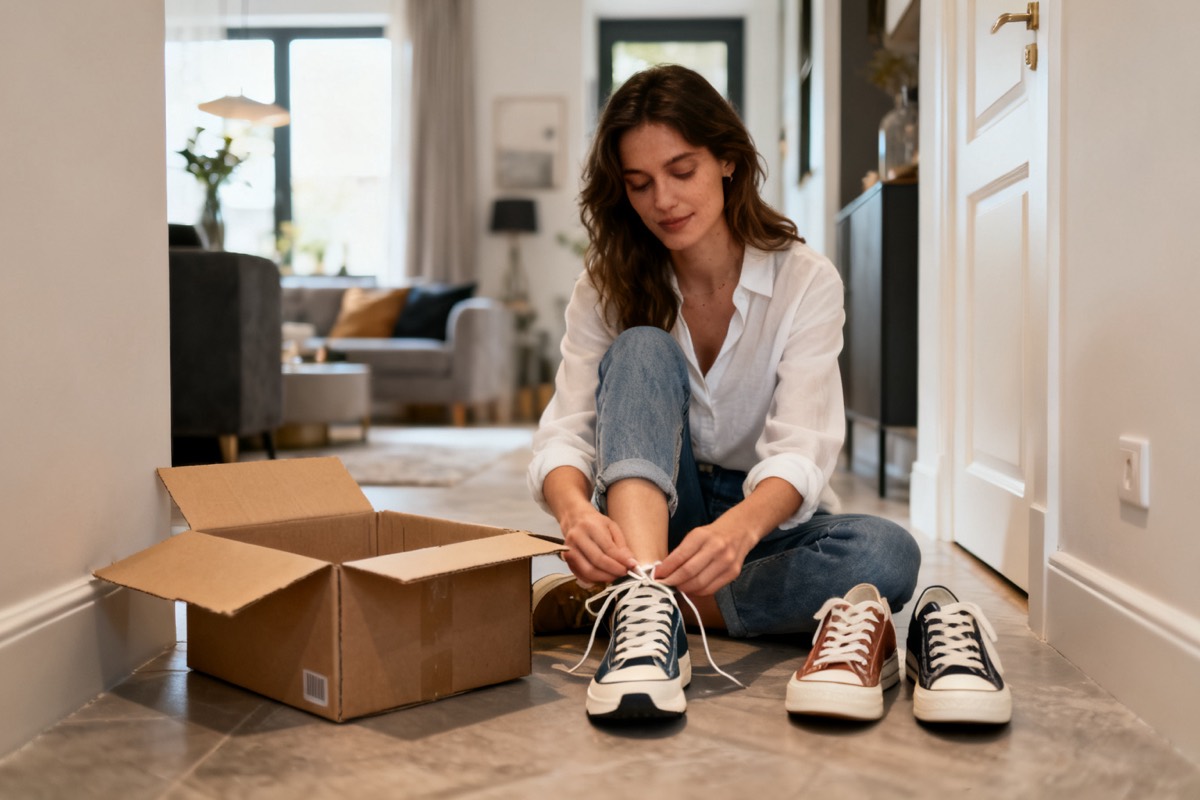
Online, the shopper loses the one tool that made shoe buying work for a century: trying the pair on. What replaces it is a number, and that number is far less standard than it looks.
The last: the shape behind the size
Every shoe is built around a last, the three-dimensional form that defines its internal volume, toe shape, and instep height. Two brands using the same nominal size can build on completely different lasts. The number on the box describes length, roughly; it says nothing about the geometry your foot actually has to live in.
This is why a shopper can be a comfortable 42 in one sneaker and cramped in another. The size did not change. The last did, and no conversion chart in the world encodes it.
Width, volume, and the data nobody publishes
Feet vary in width and volume at least as much as in length, yet most online assortments sell a single width per size and publish nothing about internal fit. The shopper with a wide forefoot or a high instep is guessing blind, and they know it, which is precisely why they hesitate or over-order.
Brand drift compounds it: sizing conventions shift between European, UK, and US scales, between men's and women's ranges, and even between seasons of the same model. The "usual size" a shopper carries in their head degrades a little with every variable.
What the Faguo A/B test showed
The practical question is whether solving fit doubt actually changes footwear buying behaviour. Faguo's A/B test of Kleep on footwear answered it: sessions with fit guidance showed a 6.7% lift in add-to-cart and a 6.8% lift in checkout against the control.
The shape of that result matters. The lift appears at add-to-cart, the moment fit doubt normally blocks commitment, and survives through checkout. Shoppers who are told which size fits do not just browse more confidently; they buy.
From sandals up: fit intelligence built for shoes
Footwear demands its own treatment, not apparel logic with a shoe icon. Ancient Greek Sandals became Kleep's first footwear client, and the approach carries the same principle that works in apparel: build a profile of the shopper's foot, then match it against the real spec of the real shoe, its last, its sizing behaviour, how the model runs.
The recommendation is per-model, not per-brand. A shopper might be one size in a closed sneaker and another in an open sandal from the same maker, and a system that cannot express that difference is repeating the size chart's original sin.

A garment a size off is a disappointment. A shoe a size off is unwearable. Footwear is where fit stops being a preference and becomes physics.
Why is shoe sizing so inconsistent between brands?
Because a shoe size only loosely describes length, while fit is determined by the last, the 3D form the shoe is built around. Different brands use different lasts, widths, and regional sizing conventions, so the same number produces genuinely different internal shapes.
Why are online shoe returns so high?
Shoes have no tolerance for near-miss sizing: a few millimetres decide comfort, and there is no stretch to compensate. Online, shoppers cannot try pairs on, so they guess from an unreliable number, bracket multiple sizes, and return what fails.
Does size recommendation work for footwear?
Yes, when it is model-specific. Faguo's A/B test of Kleep on footwear showed +6.7% add-to-cart and +6.8% checkout versus control. The key is matching a foot profile against each shoe's real fit behaviour rather than translating between size scales.
How is footwear fit prediction different from apparel?
Apparel fit is about measurements and fabric behaviour; footwear fit is about rigid geometry, last shape, width, instep volume, where tolerances are tighter. A footwear system must model how each specific shoe runs, not apply a brand-wide rule.
Conclusion
Footwear is where the fit problem is at its most unforgiving and the size chart at its most useless. The Faguo numbers show what happens when a shoe page can finally answer the fit question: shoppers commit, and the lift holds through checkout. Solve fit at the level of the individual shoe, and fashion's hardest category becomes its clearest opportunity.