
Key takeaways
- Body-scan sizing turns a phone camera into a measuring tool: two photos, front and side, in normal clothes.
- Computer vision converts the silhouette into actual body measurements, the same language garment specs are written in.
- The profile is then matched per garment against real product measurements, so the recommendation updates item by item.
- Photos beat self-reported numbers because most people measure themselves wrong; the scan captures real proportions.
- It runs alongside a 30-second questionnaire path, so every shopper picks their preferred effort level, at a combined scale of 4.2 million flows in 2025.
Two photos, one body profile
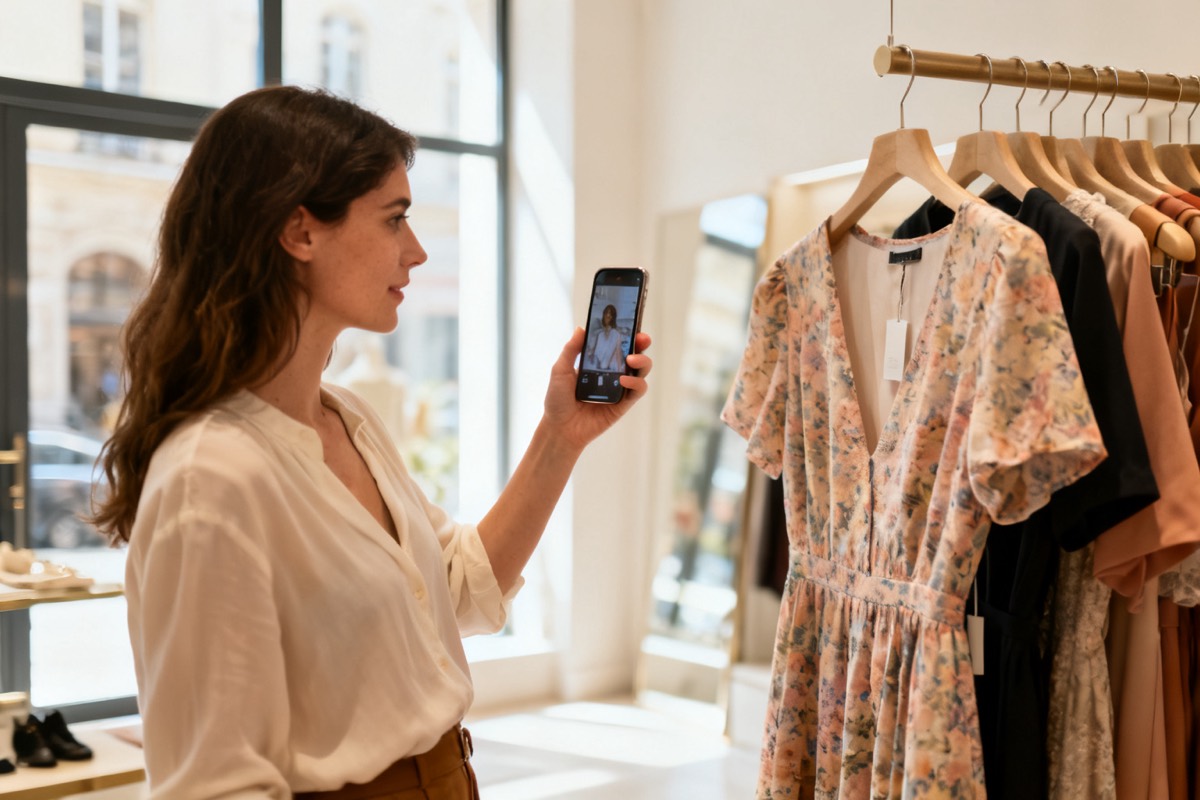
Body-scan sizing starts with something everyone already has: a phone camera. The shopper takes two photos, typically a front and a side, in normal clothes. No specialist hardware, no changing room, no tape measure, no app download standing between them and an answer.
From those images the system estimates the body measurements that matter for fit. The design constraint is honesty about context: this happens mid-purchase, on a product page, with a shopper whose patience is measured in seconds. Anything longer than a moment, and the tool costs more conversion than it saves in returns.
From pixels to measurements
Computer vision reads the silhouette and proportions in the photos and infers the key dimensions: bust, waist, hips, and the relationships between them. A reference for scale keeps the estimate grounded, and the two angles, front and side, let the model resolve depth that a single photo would have to guess.
The output is not a guess at a dress size. It is a set of measurements, the same language a garment's spec is written in. That shared language is what makes the next step accurate: you cannot meaningfully compare 'I'm usually a medium' with a garment; you can compare a waist measurement with a waistband.
Matching to the real garment
The body profile is then matched against each garment's actual measurements, not a brand-wide chart. The system knows how this specific item is cut, how much ease it carries, and how its fabric behaves, a stretch jersey forgives what a rigid poplin will not.
Because both sides are measured, the recommendation is a true comparison: this body, this garment, this size. It updates per product instead of assuming one size fits the whole catalogue, which is precisely where static charts collapse, as we show in Size Charts Are Lying to Your Customers.
Why photos beat a questionnaire for some shoppers
- No need to know or self-report measurements, which most people get wrong.
- Captures real proportions, not rounded-off guesses.
- Faster for shoppers who would rather snap than fill in fields.
- Available alongside the 30-second questionnaire, so shoppers choose their path.
Privacy, by design
A body scan only works if shoppers are comfortable using it, so the privacy architecture is part of the product. Photos exist to be measured, not kept: the purpose of the pipeline is to extract dimensions and discard the rest, and the shopper's profile is a set of numbers, not an image gallery.
The proof that the trust equation works is usage. Kleep's sizing volume grew from 17,000 flows in 2023 to 500,000 in 2024 and 4.2 million in 2025, in 2026, a flow runs every 5 seconds across 300+ brands. Shoppers vote with the camera.
How does body scan sizing work on a phone?
The shopper takes two photos, front and side, in normal clothes. Computer vision reads the silhouette, infers key body measurements using a scale reference, and matches that profile against each garment's real measurements to recommend a size for that specific item.
Is phone-based body scanning accurate enough for sizing?
Yes, for the job at hand: the two angles resolve real proportions better than self-reported numbers, which most people get wrong. Accuracy also depends on the garment data side, a good body estimate matched to real product measurements is what produces a trustworthy size.
Do customers have to use the camera to get a size recommendation?
No. The scan runs alongside a 30-second questionnaire path, so shoppers choose the effort level they are comfortable with. Both routes produce a body profile the engine can match against garments.
What happens to the photos after a body scan?
The pipeline exists to extract measurements, not to keep images: the shopper's profile is a set of numbers. Privacy-by-design is a prerequisite for adoption, and adoption at the scale of millions of flows per year suggests the trust equation holds.
Conclusion
Body-scan sizing turns a phone into a measuring tool, then matches the result to the real garment. Two photos in, one confident size out. For shoppers who will not reach for a tape measure, which is most of them, it is the most accurate path to a fit they can trust.